Chaffey High School
|
|
|
On this page:
2. Unit Synopsis Updated each unit 3. Assignments Updated weekly 4. Grades Grades will be posted on School Loop. 5. Astronomical Happenings Updated weekly 6. Links to resources Updated 27 May 2015 8. Mt. Baldy Sky Viewing Updated monthly
|
|
Of me, your teacher |
Of you, my student |
|
1. To treat you with respect at all times. |
1. To treat me and your colleagues with respect at all times. |
|
2. To provide you with an orderly environment. |
2. To attend class and participate in an orderly manner. |
|
3. To provide necessary discipline. |
3. To always cooperate and never disrupt. |
|
4. To provide competent instruction and motivation. |
4. To study and do all of your work. |
|
5. To provide the required content. |
5. To learn and master the required content. |
Our class will be its best if we each do our part!
|
|
Date |
Topic/Activity |
Assignment |
|
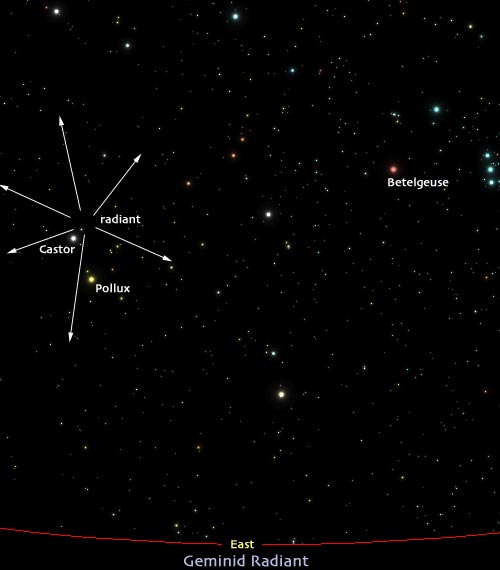
December 13-17, 2012 — The annual Geminid meteor shower peaks this weekend. The origin of the Geminids were once thought to be a long disappeared comet, but are now believed to be bits of debris related to the asteroid 3200 Phaeton. Possibly a rate of 50 meteors/hour might be seen. You will need to go outside after 9 pm and look toward the east, though meteors might be seen in any part of the sky. If you trace the path of Geminid meteors backwards, they appear to converge at the same place in the sky, called the radiant. The radiant for this shower is in the upper left portion of the constellation Gemini (hence the name Geminid) near the first magnitude star Castor. Graphic at right is from Meteor Showers Online. |
|
|
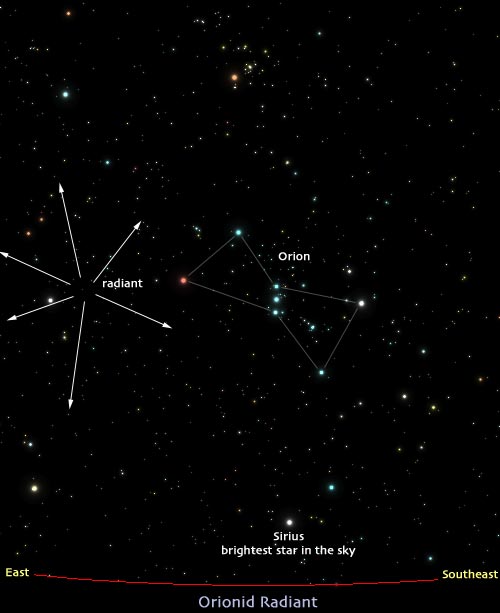
October 19-October 23, 2012 — The annual Orionid meteor shower peaks this weekend. The Orionids are caused by bits of debris shed by Halley's Comet during previous swings through the inner solar system (the last was in 1986). Possibly a rate of 50 meteors/hour might be seen. You will need to go outside after 1 am and look toward the east, though meteors might be seen in any part of the sky. If you trace the path of Orionid meteors backwards, they appear to converge at the same place in the sky, called the radiant. The radiant for this shower is in the upper left portion of the constellation Orion (hence the name Orionid). Graphic at right is from Meteor Showers Online. |
|
|
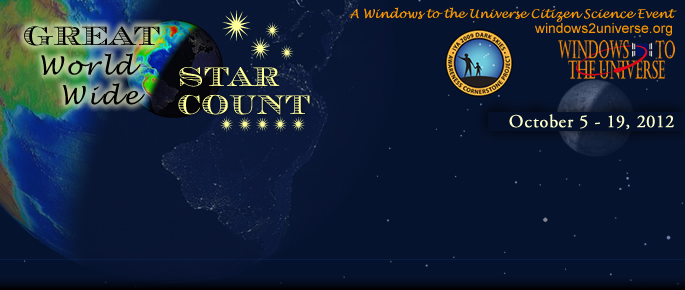
October 5-October 19, 2012 — The Great World Wide Star Count invites you to participate in a global project to measure the effects of artificial lighting on the night sky. No equipment is needed and no special travel is required. Just log onto the web site, read the easy instructions, go outside and count, then report your count with your location data and weather conditions. You may log on as many times as you like. You will be helping us to recover one of mankind's greatest heritages: The Night Sky. The map at right is by Tom Patterson of the National Park Service. |
|
|
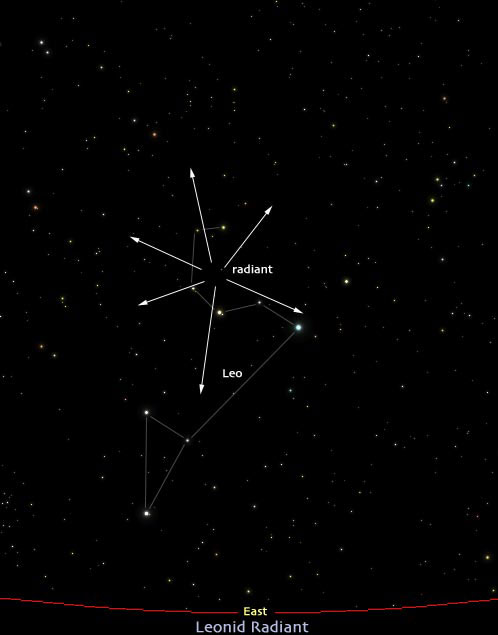
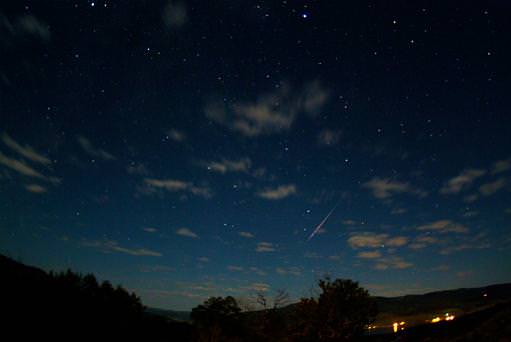
November 17-19, 2011 — The Leonid meteor shower has a relatively weak peak of around 10-15 meteors/hour early Friday morning. The third quarter moon will interfere with the viewing of fainter meteors. This meteor shower is produced by debris from Comet Tempel-Tuttle and is the same shower that produced a meteor storm in 2002. Read this nice article about the shower and its importance in meteor science history. Graphic at right is from Meteor Showers Online. |
|
|
August 10-14, 2011 — The Perseid Meteor Shower occurs this year under bright moonlit skies. From a dark site one may observe 60 meteors or more per hour, but not this year. 2012 should be much better. The best observing time is after 11 pm. Shower members may occur anywhere on the sky but their common trait is that when traced backward their paths will converge at a radiant point in the constellation Perseus. Image at right and more information are available at Universe Today. Also, timely meteor shower information can also be found at Meteorshowersonline.com. |
|
|
August 5, 2011 — The brightest asteroid, 4 Vesta, is just past opposition this week, shining at magnitude 5.7 in Capricornus. It's an easy find in binoculars in late evening and can be seen with the unaided eye from a dark site once the Moon sets. Download the finder chart for 4 Vesta and 1 Ceres from Sky and Telescope. The Dawn spacecraft, the first to orbit an object in the main asteroid belt, is orbiting Vesta and sending back high-res pictures. Dawn will spiral down to a much lower orbit for close up imaging by early 2012. At right is an image of Vesta taken on July 24. Click on the image for a higher resolution view. |
|
|
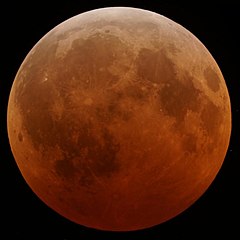
December 20-21, 2010 — The last total eclipse of the moon for 2010 will occur with the west coast of North America favored for the middle of totality occurring just after midnight. A nice article covering the eclipse can be found at Wikipedia.
Rain wiped out any chance of viewing this year's lunar eclipse. The next chances to see a total lunar eclipse from Southern California are December 10, 2012 as the moon sets (that means around 6 am!) and April 15, 2014 after midnight. There will be a total lunar eclipse on June 15, 2011, but you will need to travel to the other side of the world to view it. Wondering about a solar eclipse? A partial annular solar eclipse is visible from Southern California on the late afternoon of May 20, 2012, and another partial eclipse on August 21, 2017.
|
|
|
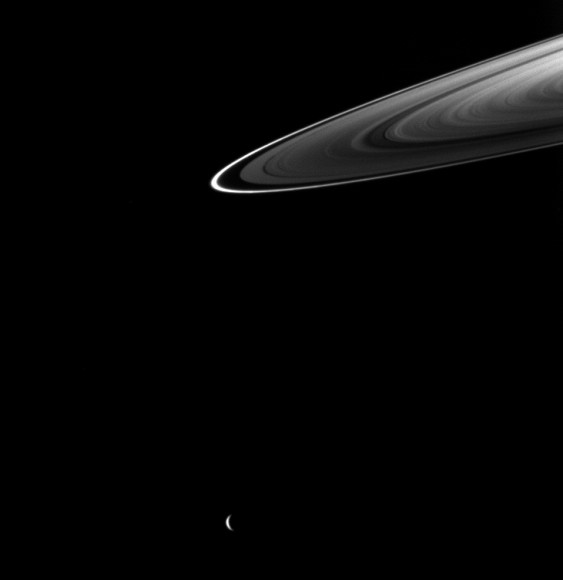
September 25, 2009 — The Cassini team released some incredible images earlier this week of the Saturn system during equinox, and followed up with this beauty of a crescent moon Rhea beneath the rings of Saturn. NASA has also put together a multimedia presentation of recent pictures of Saturn, set to music, and it is stunning. Run, don't walk and click here to watch. (Flash required) Text and image are from Universe Today. |
|
|
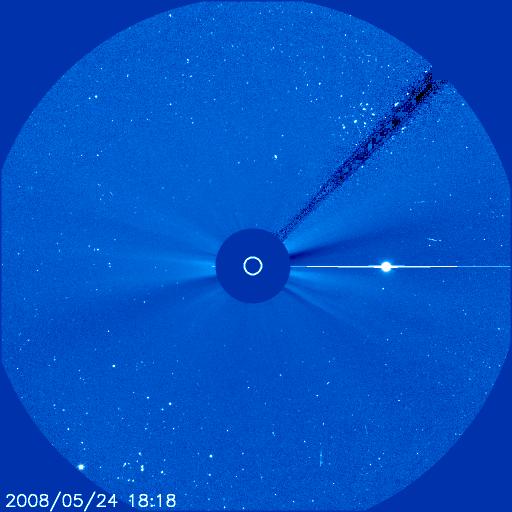
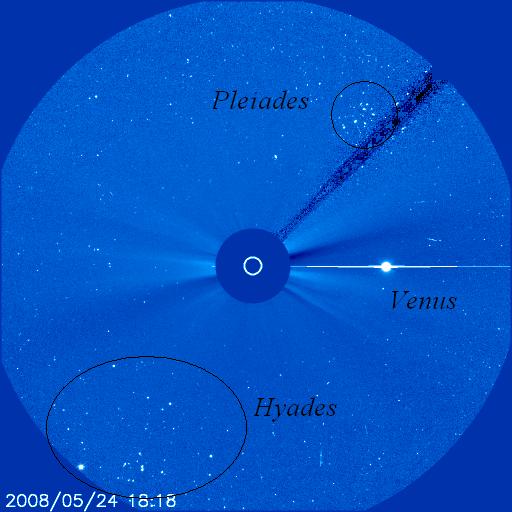
May 24, 2008 — The sun passing through Taurus is captured by the SOHO spacecraft. The Hyades, Pleiades, and Venus are all visible in the images at right. Click on each image for a bigger view. The sun's faint corona can be seen as well as the occulting disk and its bracket used to block the intense light coming from the sun's photosphere. In the Hyades, stars as faint as magnitude 10 are visible. Image credit Solar and Heliospheric Observatory Homepage. |
|
|
The Great Crossing: check out the movie made by Cassini Mission scientists of a ring crossing by the probe orbiting Saturn. Image credit: NASA/JPL/SSI. |
|



|
Current Almanac: Click here to go to Sky and Telescope's almanac section. You may enter your location (zip, city, and state) to customize for your location. Here you can obtain current sun rise and set times, moon rise, set and phase information, visible planets, International Space Station visibility predictions, and a current sky map.
Mt. Baldy Sky Viewing: Our preferred times of the month for sky viewing are between new moon and first quarter moon. This allows us to view the moon while shadows on its surface are strong but before the moon becomes excessively bright for viewing deep sky objects. Naturally, we also need favorable weather. Tentative dates are:
Normally we meet at the 4th Street parking lot, go to dinner together, then drive to the mountains. We return to Chaffey at approximately 9:30 p.m. In case our observing site is unavailable, we may set up on the Chaffey campus, either on the baseball field or on the North Quad (truly, the light pollution generated by our campus and by surrounding Ontario is a real bother!).
|
|
Yes, there is homework most days, due the next day. See the important information below and above.
If you haven't done so, register with School Loop.
In order for your child to participate in after school activities, whether on campus or off campus, we require that an insurance card and permission to attend field trip card be filled out and on file with the instructor.
Contact me by e-mail or call me at (909) 988-5560 ext. 2434 if you have any concerns regarding your student's progress in Astronomy, my teaching, or the course content. I will respond within 24 hours.
|